GEOTECHNICAL ENGINEERING1
GLOUCESTER
HomeInvestigationExploratory test pit

Exploratory Test Pits in Gloucester: Ground Truth Before You Break Ground

Practical geotechnics, field-tested.

LEARN MORE

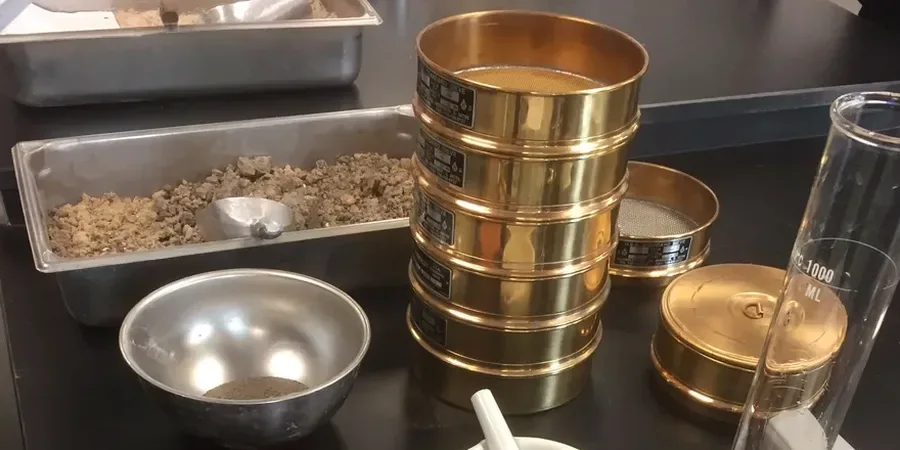
The biggest mistake we see on Gloucester sites is assuming the geology is uniform because the ground looks flat. The Severn Vale hides a patchwork of river terrace gravels, alluvial silts, and the underlying Lias Clay. Digging a borehole in the wrong spot misses a lens of soft peat that will cause differential settlement later. Our team runs exploratory test pits across the city to expose the real soil sequence. A test pit lets you see the transition between fill and natural ground with your own eyes, while a grain size analysis of sampled material confirms whether that sandy layer is well-graded or gap-graded. For sites near the River Severn or the Gloucester and Sharpness Canal, we often combine pit logging with in-situ permeability testing to check how fast water moves through the terrace gravels.

A single exploratory test pit reveals more about ground variability than a desk study ever can. In Gloucester, the difference between gravel and clay can be a matter of metres.
Our service areas

How we work

The contrast between Gloucester's neighbourhoods is stark once you open the ground. In Quedgeley, we encounter Mercia Mudstone at shallow depth beneath a thin veneer of clayey drift, which makes for straightforward logging but requires careful handling of the weathered zone. Over in Longlevens, the profile is dominated by Cheltenham Sand and Gravel, a granular deposit that collapses easily if the pit walls aren't stepped properly. The exploratory test pit methodology adapts to both conditions. We log the strata in situ, measure the depth to groundwater if encountered, and take undisturbed block samples where the clay is intact enough for triaxial testing. Where the gravel is loose, we prefer to pair the pit with a CPT probe nearby to get a continuous profile of the tip resistance without the collapse risk that comes with deep open excavation.
Exploratory Test Pits in Gloucester: Ground Truth Before You Break Ground
Technical reference — Gloucester

Local geotechnical context

Gloucester's medieval core and Victorian expansion mean many sites sit on reworked ground. The old docks, the filled-in former canal branches, and bomb-damage repair layers create a man-made stratigraphy that desk studies rarely capture. An exploratory test pit exposes these buried obstructions directly: brick rubble, timber piles, old foundations. The risk of not doing it is finding them during piling and losing a week to redesign. Where the natural Lias Clay is close to the surface, we also check for the weathered, shaly upper zone that loses strength rapidly when wetted. This material can look competent in the pit wall but turns to slurry under foundation load if drainage isn't managed. The visual inspection and hand vane readings we take in the pit provide the first real warning of these conditions.

Need a geotechnical assessment?

Reply within 24h.

Email: contact@geotechnical-engineering1.com

Applicable standards

BS 5930:2015+A1:2020 — Code of practice for ground investigations, Eurocode 7 — BS EN 1997-1:2004 Geotechnical design. General rules, BS EN ISO 22475-1:2021 — Sampling methods and groundwater measurements, CDM 2015 — Construction (Design and Management) Regulations

Typical values

ParameterTypical value
Maximum excavation depth4.5 m (standard), 6.0 m (stepped)
Sample types recoveredBulk disturbed, block undisturbed, U100 tubes
In-situ testing in pitHand vane shear, pocket penetrometer, infiltration tests
Backfill specificationCompacted arisings or bentonite seal per BS 5930
Geology loggedAlluvium, River Terrace Deposits, Lias Clay, Mercia Mudstone
Health and safety standardCDM 2015 compliance, CAT scan before excavation

Frequently asked questions

How much does an exploratory test pit cost in the Gloucester area?

For a standard exploratory test pit up to 3.5 m deep with logging, sampling, and basic reinstatement, the cost typically falls between £340 and £690 per pit. The price varies with access difficulty, the need for a mini-excavator versus hand-digging in tight gardens, and whether you require undisturbed sampling for laboratory triaxial or oedometer testing.

What is the difference between a test pit and a borehole in ground investigation?

A test pit gives you a wide, open view of the soil profile and lets you see features like lenses of organic clay or gravel pockets that a narrow borehole can miss. You can take large bulk samples and measure infiltration rates directly. A borehole reaches much greater depth and gives continuous samples in rock, but it doesn't replace the visual clarity of a pit in the top few metres where most foundations sit.

How long does it take to dig and log one exploratory test pit?

A single pit to 3.0–3.5 m depth typically takes half a day from mobilisation to reinstatement. The excavation itself is quick; most of the time goes into safe shoring if needed, detailed logging of the pit faces, sampling, and backfilling in compacted layers. If we are doing multiple pits across a site, we can usually complete three to four in a full working day, depending on travel between locations.

Location and service area

We serve projects in Gloucester and surrounding areas.

View larger map