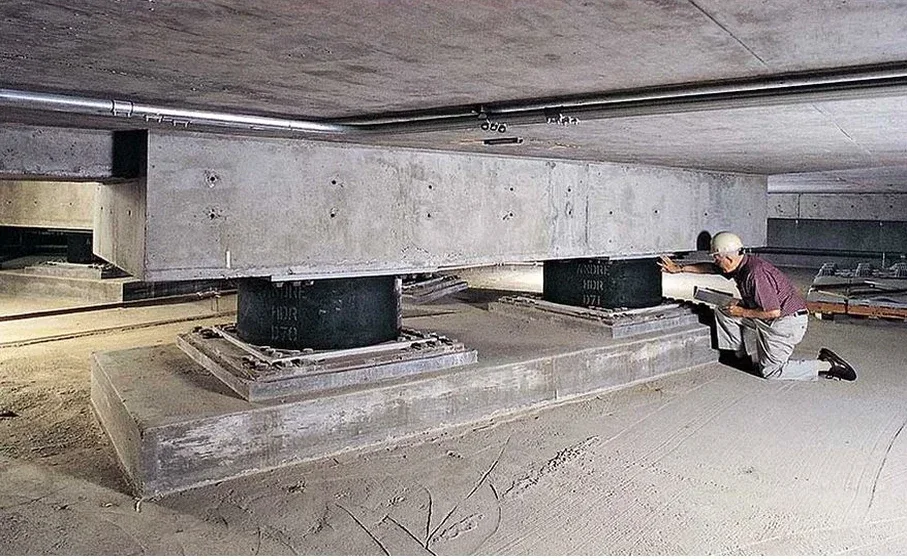
Gloucester's built environment straddles two distinct geotechnical domains: the competent Mercia Mudstone beneath the city centre and cathedral close, and the softer alluvial deposits of the River Severn corridor around Quedgeley and Hempsted. A foundation scheme that performs predictably on the stiff red-brown mudstone can encounter amplified spectral accelerations on the floodplain silts, particularly where the superficial thickness exceeds fifteen metres. Designing effective seismic isolation systems in this context demands more than a catalogue-selected elastomeric bearing; it requires a ground-motion characterisation rooted in local borehole data. Our team draws on site-specific shear wave velocity profiles and BS EN 1998-1:2004 response spectra to isolate structures from the damaging frequency content that soft Severn alluvium can transmit. The same investigation sequence often incorporates MASW profiling across the site to map the bedrock surface and identify lateral velocity contrasts that influence isolator displacement demands.
On Gloucester's alluvial corridor, the spectral acceleration at 1.0 second can be 40 percent higher than rock-outcrop predictions, a difference that governs isolator diameter and lead core size.